

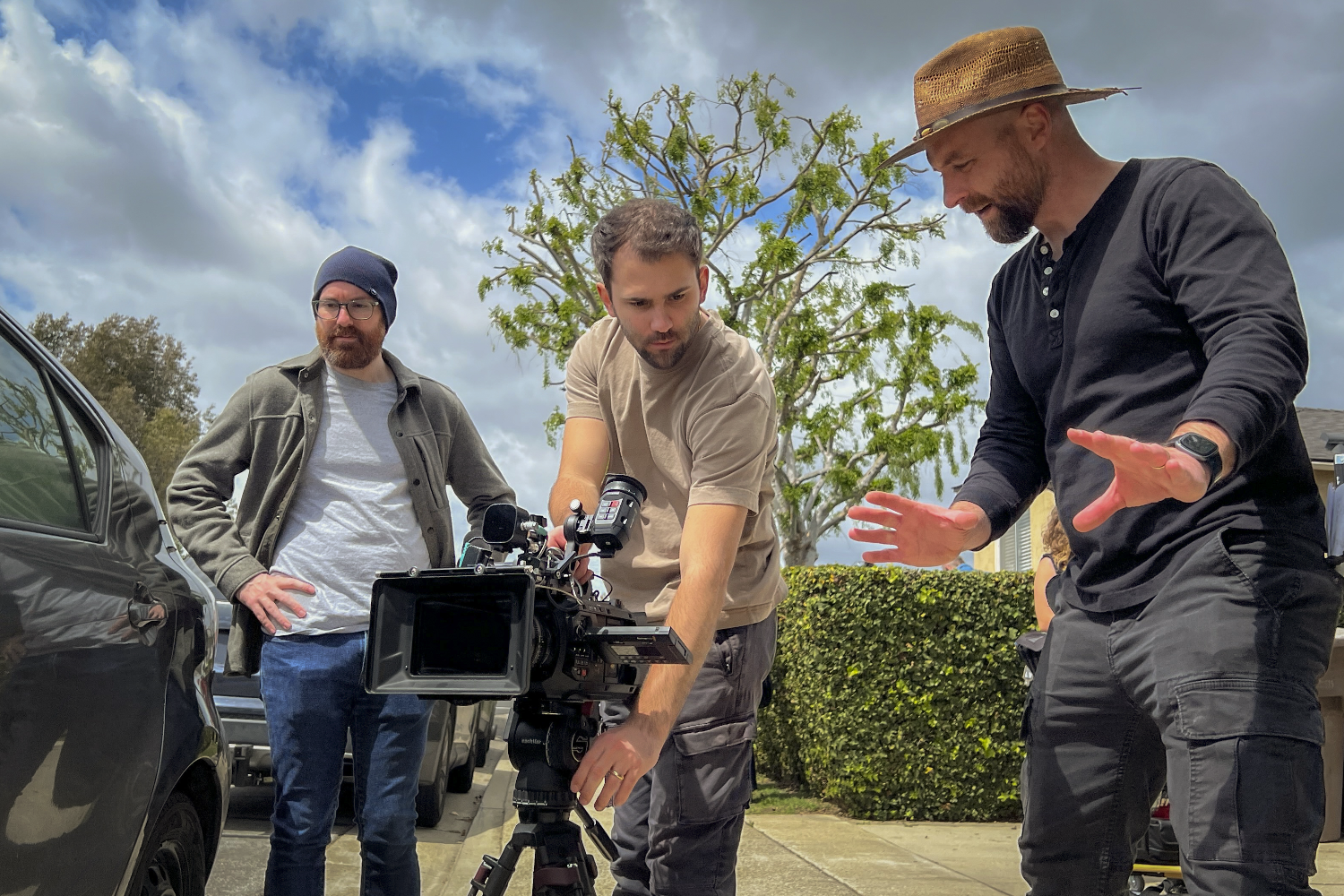
A family story becomes a short film, with a director, editor and colorist who trust each other enough to take their time getting it right.
By Marcus Roth
Several months before William Hellmuth ever picked up a camera for “All That’s Left,” his sister Rachael Watson sent him a short story she had written. The character of Jimmy was based on their grandfather, who had passed away years earlier, and the story drew from real conversations he used to have with them. Reading it hit Hellmuth in a way he didn’t expect.
“It almost felt like I was having a conversation with my grandfather,” he said.
He set the story aside and didn’t think about it for a couple of months. Then it found its way back.
Hellmuth was teaching a cinematography class at the time and wanted to organize a comprehensive on-set demo for his students. There were no projects coming up organically, so he started thinking about what he could build from scratch. That’s when his sister’s story resurfaced. He reached out to Watson, got her permission to adapt it, and together with writing and producing partner J. Scott Worthington, turned the short story into a script.
The result is “All That’s Left,” a quiet, emotionally layered short film that follows Maria, a woman in an abusive relationship who finds unexpected comfort through her friendship with her elderly neighbor Jimmy. Amber Stonebraker plays Maria. Clint Jordan plays Jimmy. The film premiered at this year’s Dances With Films festival.
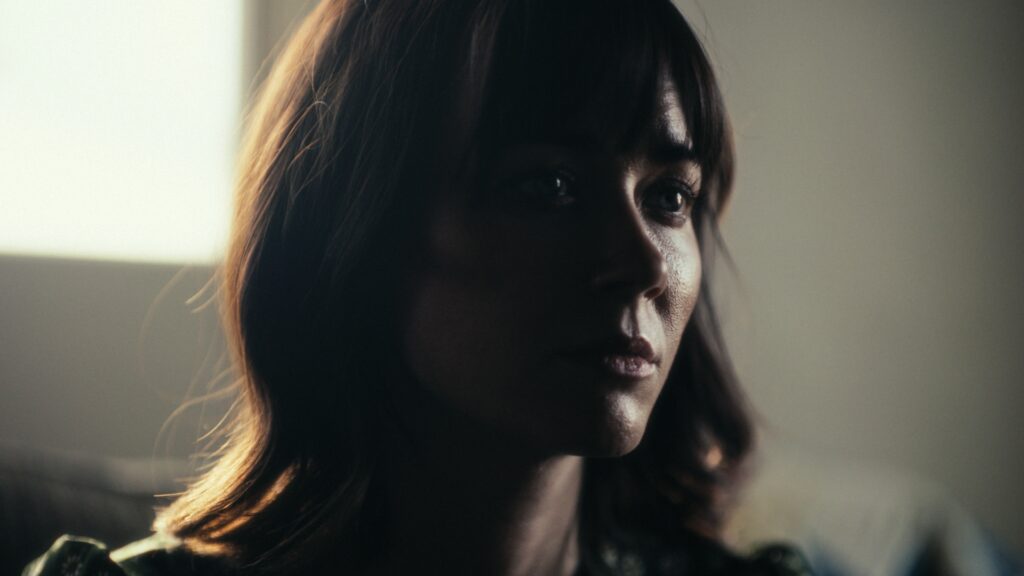
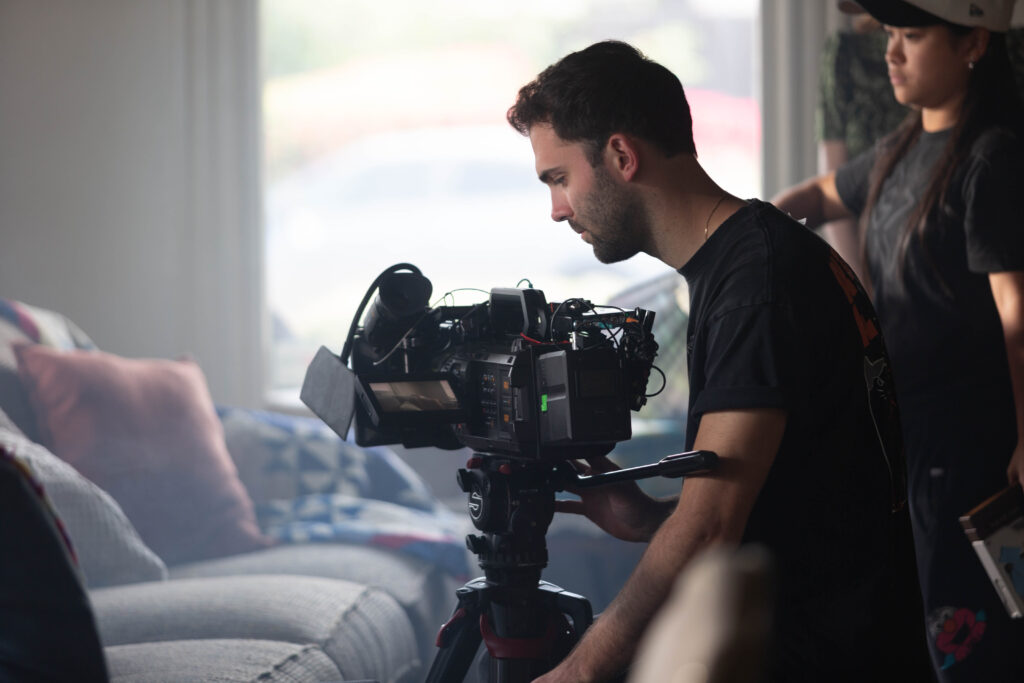 Hellmuth, who also served as cinematographer, knew from the start that the camera needed to behave a certain way for this material. He wanted the imagery to feel hyper-focused, as if everything outside Maria’s immediate world was background noise.
“When I experience a crisis and begin to feel panicked, my mind focuses intensely on whatever’s right in front of me,” Hellmuth said. “I wanted to capture that feeling.”
He used shallow depth of field and deliberate stillness, keeping camera movement minimal. The camera doesn’t chase the action. It sits and watches, giving the material the same gentleness that Jimmy extends to Maria in the story.
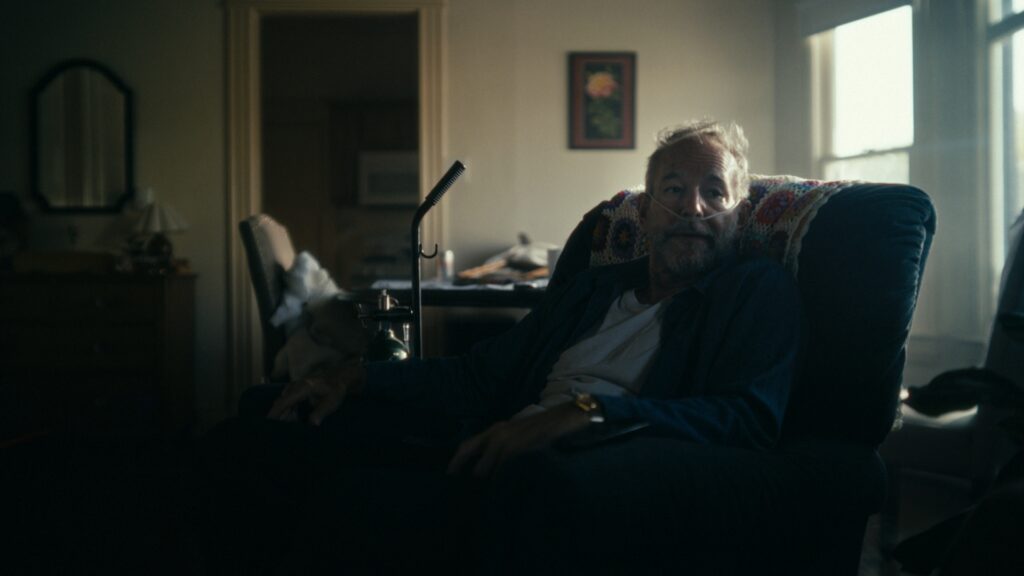
For Jimmy, Hellmuth made a specific visual choice, letting the character fall into silhouette against the space around him. “He’s a man that isn’t going to be on this world much longer, and he’ll soon be a memory just like the photos and other reminders in his house of his past life,” Hellmuth said. “I wanted the cinematography to see him as Maria might remember him while looking back on this exchange years later.”
Hellmuth shot the film on a Blackmagic URSA Cine 12K LF, a camera that was just arriving on the market as he was gearing up for production. He knew the majority of the film would take place inside a dark living room, and he needed a camera that could hold shadow detail while delivering clean dynamic range and a smooth highlight rolloff. The large format sensor gave him a practical advantage as well. “I always like using larger sensors while shooting inside small spaces to get a wider field of view without needing to move the camera back as far,” he said.
He paired the camera with Tokina Vista C lenses, which gave him the combination he was after: classic texture and bokeh with the sharpness of modern glass. Hellmuth found he could open them up all the way on wider shots to create interesting character around the edges of the frame. And because of the large sensor, he didn’t always need to shoot wide open to get the shallow depth of field he wanted.
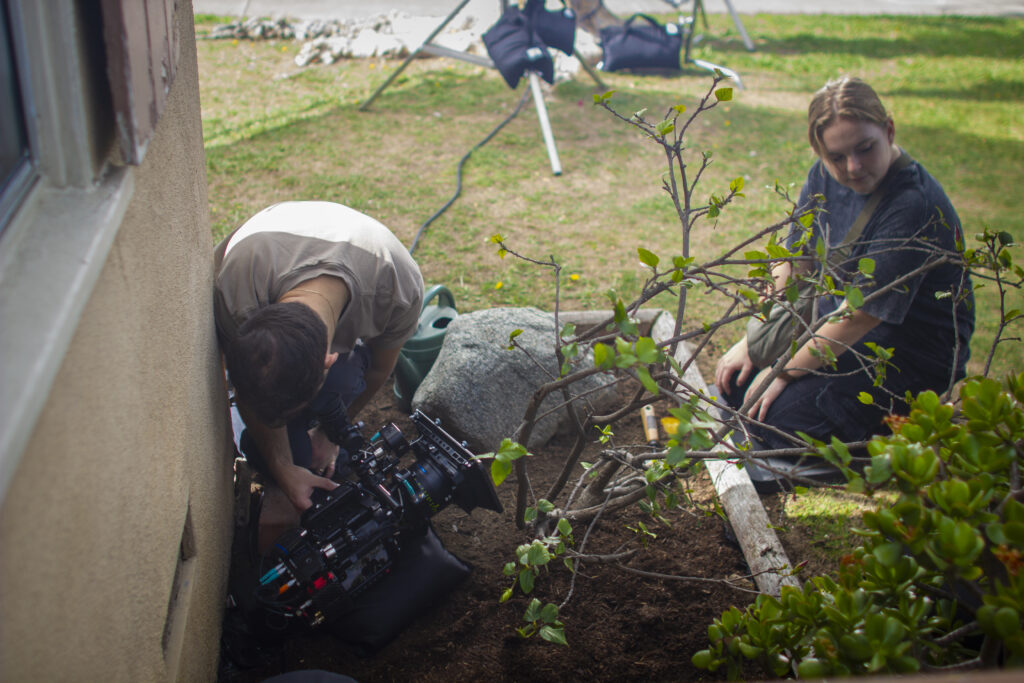 The film’s lighting tells its own story, with the exterior and interior worlds operating on completely different terms. Colorist Wes Langdon, who has been a close collaborator and friend of Hellmuth’s for about ten years, described the contrast in vivid terms.
The opening scenes, where Maria is gardening outside, put the talent directly in hard daylight. Rather than fighting the sun, Hellmuth shaped it. “With the right modification and fill, you get this otherworldly, almost dreamlike suburban exposure that really fits the look,” Langdon said. Those opening gardening shots gave Langdon some of his favorite material to work with in the grade. “There’s so much information hitting the sensor, but it’s all so well contained that you have this phenomenal color separation and a lot of headroom to try different tone curves,” he said.
Inside Jimmy’s house, the approach flips. Hellmuth starved the interior for light, leaning on exterior spill for heavy backlight and relying on edge light and catch lights to give the faces shape. The goal was to hold the contrast without losing detail in the shadows, letting the scenes live in darkness rather than compensating for it.
“The moment I came home and brought it into Resolve to watch on my big monitor, I gasped,” Hellmuth said. “The detail, dynamic range and cleanness of the image is shocking. I can let a scene live in darkness, in the lower end of the spectrum, and not lose interesting details and texture in those shadows.”
 Editor Anthony Parisi has been cutting Hellmuth’s films for years, and the two have a deep collaborative shorthand. But for “All That’s Left,” they tried something different.
Hellmuth took charge of the early editing himself, cutting the first several versions while Parisi offered feedback and ideas from a distance. Once Hellmuth felt he’d pushed the film as far as he could on his own, he passed the entire project to Parisi to refine and polish. “Anthony is a remarkable creative force in the edit bay,” Hellmuth said. “He was able to tighten up the film and preserve character moments in ways I never even thought of. His editing is always elegant in a way that it doesn’t draw attention to itself even when it’s more complex.”
Parisi said the simplicity of the story actually made the cutting more demanding, not less. “In this short, which has a certain simplicity to it with two characters talking, the ‘why’ to go to any given shot or reaction becomes magnified,” Parisi said. “It’s really delicate. There’s subtext you’re shaping when choosing each cut.”
He spent time watching each take in full before making decisions, looking for the moments that stood out in the performances. For Parisi, protecting the actors’ best work is a core part of the job.
“There’s a quiet, restrained approach to the photography that really set the tone for the cutting and the hushed way it should sit and linger moment to moment,” Parisi said. He pointed to the later living room scenes as his favorite section to work on, where the subtext between the two performances required careful handling. “Seeing her reactions and processing there was key since the story is about her character’s internal wrestling,” he said.
Parisi also described weaving impressionistic flashes of Maria and her daughter into the timeline, feeling out the right placement for each one without breaking the film’s delicate tone. He paired them with the sound of wind chimes, which he felt matched the movement and flow of the images.
 Langdon’s grading process started with work he and Hellmuth had already done together. A LUT that Hellmuth had been using in-camera was originally developed for a previous feature the two had nearly collaborated on. In post, Langdon started from that originating PowerGrade and refined underneath it at the group level, keeping the foundation intact while adjusting the tone.
From there, the two spent time auditioning different directions before arriving at the final look. “We spent a lot of time going back and forth auditioning a few different looks before we landed on the cool, slightly desaturated look we used here,” Hellmuth said. “Wes has a willingness to experiment and try new things that is very refreshing and energizing.”
Langdon described his general approach: he starts by watching the reference render to understand what the team has been living with throughout editorial, then reviews any reference images or lookbooks. From there, he asks what the director has been wanting to fix, what color problems came up on set, and whether any stakeholders have preferences he should keep in mind.
On the technical side, Langdon works with a fixed node tree at the clip level, with post-group nodes handling the overall look. He sets up multiple output types on bypassed nodes to suit different delivery requirements. When delivering web assets specifically, he adds a color space transform at the timeline level to compensate for the gamma shift that happens when content goes online, a detail that can quietly wreck a carefully graded image if left unaddressed.
He pointed to DaVinci Resolve Studio’s Fusion page as a regular part of his workflow, not for full visual effects work but for what he calls “power edits”: complex retiming, nuanced tracking and stabilization, custom titling and end credits. He also singled out the AI powered Voice Isolation tool. “The AI Voice Isolation is literal witchcraft,” Langdon said. “I use it constantly, even just at 10% to clean up the room a bit.”
Both the edit and the grade were done in DaVinci Resolve Studio, a choice that Parisi said kept the process fast and eliminated the friction of moving between applications. “The cutting tools are fantastic and it’s so nice not ever having to leave the program for color,” Parisi said. “It just makes sense to keep it all in one place.”
Each collaborator worked in their own project files rather than sharing a single session, but being in the same software made passing work between departments straightforward. “We were all in Resolve, so sharing project files was extremely easy,” Hellmuth said.
For a film that started as a family memory and grew into something larger through a classroom exercise, “All That’s Left” carries a process that mirrors its own tone. No one was rushing. Hellmuth trusted Parisi enough to hand the edit over entirely. He and Langdon had a decade of visual shorthand to draw from. The tools never got in the way.
“All That’s Left” premiered at the 2026 Dances With Films festival.
Production Credits
| CREW | |
| Story | Rachael Watson |
| Screenplay | William Hellmuth, J. Scott Worthington |
| Producer | J. Scott Worthington |
| Director | William Hellmuth |
| Cinematographer | William Hellmuth |
| Editor | Anthony Parisi |
| Colorist | Wes Langdon |
| GEAR | |
| Primary Camera | Blackmagic URSA Cine 12K LF |
| Primary Lenses | Tokina Vista C |
| Editorial Software | DaVinci Resolve Studio |
| Color Software | DaVinci Resolve Studio |